
Nutrition for bone health:
Calcium, vitamin D, and other strategies to prevent osteoporosis 

Strong bones are crucial to good health, and good nutrition is crucial to strong bones. Find out what you need to protect the health of your skeleton for years to come.
Nutrition strongly affects bone health throughout our lives. For instance, what our mothers eat while pregnant with us will affect our eventual bone mass as adults.
As children, our bones are almost exploding with rapid growth. If we break something, no problem — we knit back together like Plastic Man. (Which is good, considering how many times we’ll probably fall face-first off the monkey bars.)
By around 18 or 19 years old, we’ve reached about 95% of our peak bone mass. We can continue to build some bone in our 20s.
But by age 30, we stop making any more “bone deposits”. Then the withdrawals start.
This leads me to some bad news and some good news.
The bad news: You’ll lose bone density
Most people in the U.S. lose about 0.5% of bone mass each year after the age of forty. Chronic bone loss leads to low bone mineral density and the deterioration of bone tissue – otherwise known as osteoporosis.
It gets worse.
Fractures from osteoporosis are more common than heart attack, stroke, and breast cancer combined. At least one in three women and one in five men will suffer an osteoporotic fracture during their lifetime.
Osteoporosis is often known as the “silent thief” because the disease proceeds without symptoms.
Many older adults are not aware that they have weak bones until they happen to fall. Women typically lose bone mass drastically during menopause, when bone-protecting hormone levels drop.
And if you’re elderly and you fracture a bone, your chance of dying shortly afterwards skyrockets.

The good news: You aren’t doomed
Luckily, there is a lot you can do even as an adult to protect and even strengthen your bones.
If you understand how bones work, then you’ll understand how you can use good nutrition to keep them strong, solid, and healthy.
What is bone made of?
Bones may look hard and unchangeable. They don’t seem to do anything much.
But like any part of the body, they’re dynamic, living tissues. They’re constantly breaking down and remodeling themselves. In fact, you end up with a completely new skeleton about every 10 years.
And bones aren’t just hunks of minerals, either. Much of the bone structure is actually protein, and contains connective tissues (such as the endosteum or periosteum), a network of nerves and blood vessels, and of course the marrow at the center.
Thus, good nutrition doesn’t just support bone mineralization — it helps the whole skeletal complex stay healthy too.
Bone remodeling
When bone cells sense any strain (for example, the impact of striking your foot on pavement as you run, or bearing the load of a barbell), the body sends signals to increase bone formation.
Good nutrition, good remodeling
If we’re well-nourished, then our bones remodel themselves robustly.
Imagine a well-trained construction team renovating a house with high-quality materials.
Microtrauma — tiny cracks and damage — tell the bones to adapt, repair, and ultimately strengthen. Old bone is removed and new bone is laid down. All is well.
If we aren’t well-nourished, then our bones don’t recover well.
Imagine the same construction crew — but this time, their materials are cheap and poor quality. They don’t have the items they need. Maybe they cut a few corners just to get the job done.
The resulting structure is shoddy. New bone isn’t laid down. The old bone just gets weaker over time.
Here’s another piece: As this work crew ages, their efficiency declines. Even when they do have the right materials, they work more slowly.
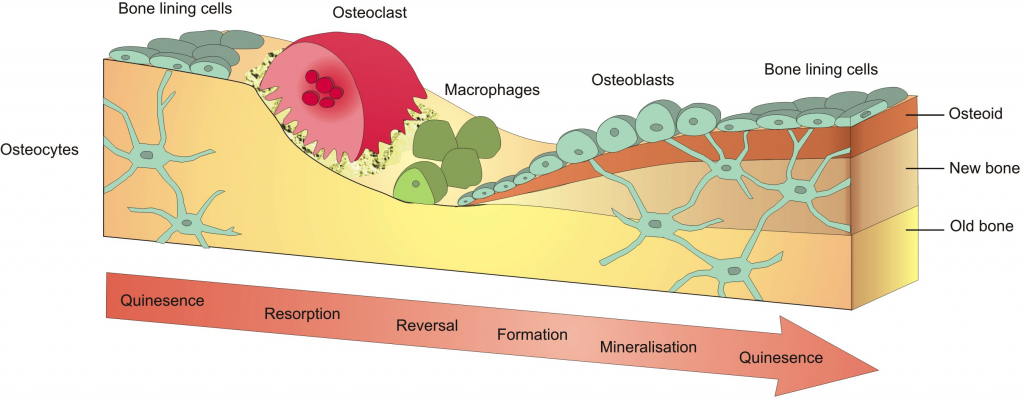
Bone remodeling process.
Nutrition for strong bones
At this point, you’re probably wondering what you can eat – or stop eating – to ensure the healthiest bones possible.
Luckily, it’s simple. Eat a balanced diet of whole, fresh foods. Combine that with regular exercise (so that your bones get the signal to remodel). And your bones will support you for years to come.
Here are some specific nutrients that are involved in bone health.
Calcium
Bone contains about 99% of the body’s calcium, and we need calcium to build bones. That’s why health professionals often tell us to make sure we get enough calcium.
Most folks need between 600-1200 mg of dietary calcium daily. Teenagers probably need the most to support their growth spurts.
Here are some things to keep in mind about calcium:
- Does your body know it should use that calcium? Though calcium is important, it’s not enough to build a strong skeleton on its own. It needs hormonal signals (such as enough vitamin D) and mechanical signals (like impact and loading) to tell it where to go.
- Can your body absorb that form of calcium? We can eat plenty, but our bodies have to be able to use that calcium.
- Is that calcium in balance with other nutrients? Recent evidence suggests that we don’t benefit from supplementing more than 1000 mg of calcium daily — and in excess, supplemental calcium can actually be harmful.
- Are you eating other foods, or taking other medications, that could interfere with calcium absorption? For more on

CONTACT@9966047658


No comments:
Post a Comment